Some Missing Dots
Raymond Saner & Lichia Yiu (2023), in Michel Carton & Christine Hofmann (Eds), The Education-Training-Work Continuums: Pathways to Socio-Professional Inclusion for Youth and Adults. Norrag and International Labour Organisation. NSI 08: 110-114.
An educational governance system based only on input or output measures is neither satisfactory nor effective. An innovative and adaptive governance system needs to monitor the outcome and impact in order to know whether an education–training–work system has achieved its mission. This chapter proposes a governance infrastructure to guide and coordinate six education–training–work transformations, namely, human capacity and demography; consumption and production; decarbonization and energy; food, biosphere, and water; and smart cities and digital revolution.
Raymond Saner, Lichia Yiu and Philippe Lévy (1999) “Reforma della pubblica amministrazione e qualità: l’esperienza della Svizzera” (Quality Assurance and Public Administrative Reform: New Developments in Switzerland ”.
Azienda Publica, pp 583-595, Italy.
SENAC/ABNT Sao Paolo, 20th April, 2001
Author: Raymond Saner
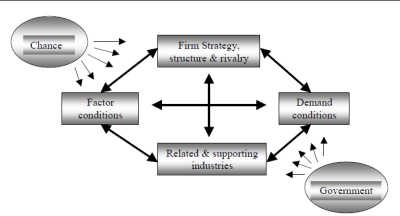
This article sets out to provide an overview of the field of national competitiveness studies and its relation to high quality human resources and correspondingly to high quality education and training. In particular, the author’s goal here is to develop the reasons why countries increasingly need well trained and motivated human resources. Drawing on Michael Porter’s pioneering work on national competitiveness and Christophe Koellreuter’s application studies on regional competitiveness , the author highlights the importance of high quality human resources in general and of high quality education and training in particular. In conclusion, suggestions are made to establish a quality assurance systems of education and training based on the newly developed ISO 10015 Standard in order to guarantee high quality levels of learning necessary for sustainable economic development and successful enterprise performance.
Information pertaining to Negotiation Theory and Practice, Diplomacy and State versus Non-State Actor relations can be found on this website: www.csend.org and on the website : www.diplomacydialogue.org
Raymond Saner “Differences between Mediation and Negotiation”
(original in German: Abgrenzung zwischen Mediation und Verhandlung)
Published in “perspektive mediation – 2005/ 3”
Raymond Saner & Lichia Yiu
The purpose of this paper was to assess how far Jamaica has come regarding women economic empowerment, female entrepreneurship and its development policies in favour of women entrepreneurship development. The study thus provides a rare glimpse of the entrepreneurship ecosystem in Jamaica.
While global policy has been promoting women empowerment through entrepreneurial development, little is known on the actual outcome of such human capital investment strategy and the critical vectors that contribute to such outcome. This scarcity of knowledge is also applicable to Jamaica.
This paper attempts to contribute to women entrepreneurship research by reaching beyond the output-oriented perspective of various skill development programmes and attempts to link policy choice with overall macro results of entrepreneurship development in general and women entrepreneurship development in specific.
This thematic issue provides analysis of case examples of negotiation processes of strategic alliances. Negotiation theory is applied to concrete M&A as negotiations as well as to other forms of negotiations of strategic alliances, for instance between governments, between private sector companies and cross-sectoral alliance negotiations between private sector actors and other actors such as governments. The chapters consist of the following topics:
Business diplomacy and international strategic alliances
Raymond Saner
Applying a trust lens to the study of international strategic alliance negotiations
Michael Jeive
The Lafarge-Holcim merger negotiations
Eva-Maria Knittel; Juan David Berdugo; Kamontip Cheevavichawalkul; Marya Imbach
EJIM is a leading journal with European and global perspectives, devoted to advancing international management research, practice and policy. Papers deal with regional, international or comparative issues affecting management scholars and practitioners. EJIM attempts to understand why and how firms manage the movement of people, information, money and products in the context of differing political, economic, social, ecological, competitive and technological environments. It seeks conceptual, theoretical, methodological, empirical, qualitative and review papers advancing the field of international business and management.
Special Issue (2019) NEGOTIATING INTERNATIONAL
STRATEGIC ALLIANCES: EXAMPLES OF SUCCESSES AND FAILURES; Guest Editors, Michael Jeive and Raymond Saner,
European Journal of International Management
Volume 13, No. 5, 2019, pp 581-709.
Raymond Saner and Lichia Yiu discuss a large system transformation project they designed and implemented in Slovenia at the start of its independence in the early 1990s. Post-mortem insights are useful for practitioners who embark on similarly broad transformation processes. Design issues are discussed such as structuring the pre-contracting phase to guarantee inclusive stakeholder representation and participation throughout the transformation process and how intervention design needs to allow for experimentation and multi-stakeholder alliance building. Application of action research and action learning in a risk-averse environment typical of central governments helped create a sense of ownership, control, and collective accountability in the partner country.
Yiu, Lichia; Saner, Raymond : (2006-2007), “ WITKIN’S COGNITIVE STYLES AND FIELD THEORY APPLIED TO THE STUDY OF GLOBAL MANAGERS AND OD PRACTIONERS”
There has been an upsurge of publications based on Hermann Witkin’s ground breaking work on cognitive styles and human perception differentiated into field dependent and field independent styles (Winerman, 2006, Nisbett et all, 2005, Nisbett, 2003). This paper builds on current and past research of Witkin et al., and applies his concepts to the study of global managers and OD practitioners. The goal is to describe core aspects of culture related challenges which global mangers and OD practitioners have to overcome, and ends with proposing future research on possibilities of training global managers and OD practitioners in order to develop Integrated Perceptual-Cognitive Ability (IPCA). Such an IPCA competence would allow them to master both field-dependent and field-independent perceptual-cognitive skills.
Raymond Saner and Lichia Yiu, 2017, Matlin S. & Kickbusch, I. (eds.) “Pathways to Global Health: Case Studies in Global Health Diplomacy (Volume 2)”, Global Health Diplomacy, vol. 5, p.171-210.
The goal of this chapter is to describe and analyse the multi-stakeholder negotiation process which unfolded during the negotiation of the World Health Organization’s (WHO) Framework Convention on Tobacco (FCTC), including the influencing and negotiation behaviour of the different stakeholder groups and how their disputes resulted in the completion of the FCTC, the initiation of negotiations and agreement on a protocol for FCTC Article 15 (the illicit trade in tobacco products), and the unfinished negotiations towards a protocol for FCTC Article 13 (tobacco advertising, promotion, and sponsorship).
Saner, R.;“Organisational Consulting- What a Gestalt Approach Can learn from Off-Off-Broadway Theater”. Gestalt Review, Vol.3(1): 6-21, 1999.
Saner, R., Strehl, F., Yiu, L.; “La Formation Continue Comme un Instrument Pour Le Changement Dans L’Administration Publique“. (English and French). International Institute of Administrative Sciences, 1997.
Saner, R., Yiu, L.;"European and Asian Resistance to the Use of the American Case Method in Management Training: Possible Cultural and Systematic Incongruencies". The International Journal of Human Resource Management, 5 (4): 953-976, 1994.
Raymond Saner organised a panel on « Autonomy and Control : Basic Issues for Public Enterprises in a Competitive Environment » during the annual conference of the International Institute of Administrative Sciences (IIAS) in Vienna in 1992. Delegates presented cases showing how their public enterprises face the competitive pressures in their respective economy be this from private sector or other public sector enterprises. 18 delegates came from 15 countries and two delegates from international organisations (ILO, ARADO) presented their case analyses and subsequently engaged in lively discussions. This article served as a background paper for the subsequent presentations and discussions.
Raymond Saner*, Lichia Yiu, Mario Filadoro and Victoria Khusainova in Asia Pacific Journal of Public Administration (APJPA),
Volume 37, Issue 3, 2015, pp 193-206
Water plays a central role in the life of society. However, factors such as population growth, pollution and poor allotment and distribution mechanisms place severe pressures on adequate and equitable water supply. In response, the discussion here contributes to the debate about whether and how water should and can be provided by governments only or with private and social sector participation. Four options are addressed.
This Round Table offered an opportunity to exchange between diplomats, representatives of international organizations, experts, academics, researchers, journalists, and civil society actors, the principles and activities that contribute to sustainable development in a globalized world in constant change. In an open discussion, panelists, who are experienced professionals, expressed their opinions and made recommendations. During the second part of the Round Table, the panelists focused on different issues relevant for sustainable development such as security (inside and outside borders), employment, education and training, health, environment and sanitation of the environment, and information and communications technology (ICT). The event was organized by CSEND and COMDEV in collaboration with the Geneva Welcome Center and the Swiss Press Club.
Raymond Saner and Lichia Yiu, (2014) “Learning to Grow: A Human Capital-focused Development Strategy, with Lessons from Singapore”.The authors argue that a key challenge for middle-income countries is to avoid ‘the middle-income trap’. In this situation, economic growth has come to a halt and a country is unable to transition to the next level in part due to inadequacies in high-level human capital. Taking the example of Singapore as a country that has avoided the middle-income trap, the authors call for ‘a much closer alignment of policies for human capital and economic development’ and a ‘human capital focussed development strategy’.(2014). This paper including a response by S. Gopinathan and others is also available at: http://poldev.revues.org/1803; to be cited as: Raymond Saner and Lichia Yiu, “Learning to Grow: A Human Capital-focused Development Strategy, with Lessons from Singapore, in “Policy Debate | Learning to Grow Beyond the Middle-Income Trap - Singapore as an Export Model?” by Raymond Saner, Lichia Yiu and S. Gopinathan, International Development Policy, Graduate Institute, Nr. 1803, University of Geneva
Studying cross-border regions requires an interdisciplinary approach consisting of among others micro-economics (competitive firm behaviour, local labour markets), spatial economics (rural and urban planning and architecture), policy analysis (regulatory function of government), urban geography (migration patterns), institutional sociology (administrative culture), social psychology (social cohesion) and cultural anthropology (comparative religion and values).
Scholars from different academic disciplines have studied conflict and negotiations over the past centuries going back to ancient times2. This holds not only for Western societies but for the world at large. Whether highly developed with codified norms and written rules or nomadic and based on narrative culture, societies tried to make sense of conflict and attempted to develop conflict resolution methods.
Global Economic Governance from the Perspective of a "Small State" - Economic Diplomacy of Switzerland
Published by the Economic Diplomacy Programme, SAIIA, Occasional Paper, No 124, November 2012.
Accessible at Website
How can organizations like the United Nations, the World Bank, the World Health Organization, and the Red Cross become more effective in their vital and laudable mission? How can multinational corporations contribute meaningfully to global issues like climate change, poverty reduction and equitable economic growth? What enables enterprises to grow and develop in challenging settings like the aftermath of a devastating Tsunami?
These questions are all related to humanitarian work psychology and have so far been largely overlooked by global development policy and policy makers. A first roundtable was organised in Geneva to discuss the relevance and needs to form a new area of study, namely, humanitarian work psychology in order to effectively address the needs of the humanitarian workers.
This annotated bibliography covers those publications analyzing the link between Culture and International Negotiations. A special focus on WTO and Trade-related Negotiations was adopted while doing the literature selection.
A total of 32 publications available from the public domain were selected. They comprise books, articles in specialized journals and electronic sources. Publications selected and annotated are relevant for researchers interested in conducting further studies on Culture and International Negotiations as well as Culture and Multilateral Trade Negotiations.
NEGOTIATIONS: Contributions by Scholars from Social and
Economic Sciences, Raymond Saner, 2010, Diplomacy Dialogue, CSEND
Summary of AoM meeting 2010 Montréal/Canada, 9TH August, 2010 (Session 706)
 Education is a central priority for the State of Santa Catarina. Its policy makers are firmly committed to providing a relevant and efficient education system that responds to the requirements of the global economy and allows the state to be competitive, both nationally and internationally.
This OECD review gives a brief overview of education in Santa Catarina and its development. It presents an analysis of the system from pre-school to tertiary education and lifelong learning, and identifies key directions for policy reform in light of the challenges encountered by officials, communities, enterprises, educators, parents and students. It concludes with a set of key recommendations concerning the structure of the system and its labour market relevance; access and equity; governance and management; research, development and innovation; internationalisation; and financing.
 Today's world has gone beyond state-to-state negotiations. While these traditional forms of engagment still exist, the more rapid developments have occurred at the boundary of social and political conflicts. The State's strict jurisdiction over diplomacy as a tool for conflict resolution is being increasingly challenged by economic actors and civil society actors. This new overlapping of convergent and divergent interests between these multiple actors is the focus of the book.
AoM Caucus on applying ODC in developing and least developed countries to help reduce poverty, support employment creation and strengthen sustainable development
Written by Super UserResearch Report on Employee Turnover Survey in India. A joint study of Confederation of Indian Industries and Centre for Socio-Eco-Nomic Development. Lichia Yiu and Raymond Saner, 2008. Author: Saner, R., Yiu, L.
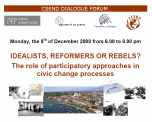 The CSEND Dialogue Forum held a session on the 8th of December 2008 on the topic of "The role of participatory approaches in civic change processes" presented by Christine Ziegler, an expert for participatory processes.
Place: University of Geneva, Uni Mail
 The Centre for Socio-Eco-Nomic Development (CSEND) is pleased to invite you to a CSEND Dialogue Forum session on the topic of Creating Sustainable Decent Work Conditions for the Informal Sector workers in India presented by Mr Solomon on the 20th of October 2008.
Place: University of Geneva, Uni Mail
 The Centre for Socio-Eco-Nomic Development (CSEND) is pleased to invite you to a CSEND Dialogue Forum session on the topic of Implementing Sustainable HeritageTourism in the Caribbean presented by Dr. Keith Nurse on the 6th of October 2008.
Place: University of Geneva, Uni Mail
 CSEND is pleased to present Dr. Aboubakr Abdeen Badawi as the speaker at the CSEND Dialogue Forum. The forum is entitled “Career Guidance, Migration, Labor Markets’ Efficiency, Quality of Training and Democracy: Is There a Link?” and is scheduled for the 23rd of July, 2008.
Place: Uni-Mail, Room M R170, Geneva
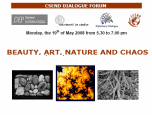 Third edition of CSEND Dialogue Forum on the topic of "Beauty, Art, Nature and Chaos" presented by Prof. John Briggs, on the 19th of May 2008, at University of Geneva, Uni Mail.
Place: Uni-Mail, Room M S030, Geneva
 Second edition of CSEND Dialogue Forum on the topic of "The Arts as Inspiration for Innovative Social Change" presented by Prof. Pierre Guillet de Monthoux on the 15th of October 2007, University of Geneva, Uni Mail.
Place: University of Geneva, Uni Mail
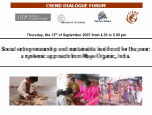 Announcing the first CSEND Dialogue Forum on the topic of "Social entrepreneurship and Sustainable Livelihood for the Poor" with a case example from Maya Organic in India. 13 Septembre 2007
Place: Uni Mail, University of Geneva, Room 1130
Benchmarking conference on "Best Management Practices of In-Service Training Functions" for Swiss and Chinese officials, and executives of state-owned Chinese enterprises, Geneva, 1996.
Place: Geneva
Place: Paris
Place: Quebec
Seminar on "Telecommunications and Information Technology:Tools for Sustainable Development in Asia (jointly organised with International Telecommunication Union). A programme seminar organised in conjunction with the Annual Meeting of the Board of Governors of Asian Development Bank,Geneva, 27-29 April, 1997.
Place: Geneva
SME Development in Economically Depressed Areas: A World-wide Comparative Evaluation of Organisational Goals, Vitality, and Outcomes
Written by Super UserPlace: Chicago
Cross-Border Transfer of Management Knowledge for Large System Change
Written by Super UserPlace: Chicago
Management and Organisation Development Across Borders: The Use of Technology Based Learning Processes by Multinational Companies
Written by Super UserPlace: Chicago
European Entrepreneurship and Small Business Research: Methodological Openness and Contextual Differences
Written by Super UserPlace: San Diego
Place: San Diego
Action Learning with Virtual Transnational Teams: Management Training in Asia
Written by Super UserPlace: San Diego
Conducting Change Projects in the United Nations and Related Intergovernmental Organisations: How to Deal with Porous Boundaries?
Written by Super UserPlace: Boston
Information Technology & National Competitiveness in Developing Countries
Written by Super UserPlace: Boston
The International Monetary Fund's Influence on Trade Policies of Low-income Countries: A Valid Undertaking? (August 2007).
Author: Saner, R. & Guilherme, R.
Saner, R. "A challenge for international youth development: commitment and values -in search for universal love, friendship and understanding". International Youth Conference, Chinese Taipei, 1989.
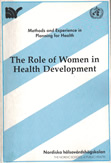 Staugard, F. (Ed.). The Role of Women in Health Development, The report of an international workshop held at the Nordic School of Public Health, 5-9 June, 1989.
Author: Saner, R. & Yiu, L.
 This chapter provides an overview of the non-formal management education and in-service training and identifies various assessment tools used in Western Europe and Northern America. The chapter ends with an examination of options of safeguarding the value of non-formal management education and management development programmes in the spirit and context of life-long learning. Published in June 2009 in The Sage Handbook of Management Learning, Education and Development by Steven J Armstrong and Cynthia V Fukami. Author: Lichia Yiu, Raymond Saner
 Human capital is seen as one of the key factor conditions contributing to national competitiveness and economic performance (Porter, 2002). Productivity performance of OECD countries tends to correspond to the skill levels of the workforce in specific countries. Hence, governments increasingly view human capital formation, both quantity and quality of workforce, as one of the key levers in ensuring sustained productivity gains and standard of living.
Author: Yiu, L., Saner, R.
Saner, Raymond, Yiu Lichia, “ Renforcer la corrélation entre formation et performance”, in Persorama, Nr. 4, 2006, pp. 44-46
 Saner, R. "The Need for Quality Assurance Systems of Training and Education in China to ensure Competitiveness and Sustainable Socio-Economic Development". Technoeconomics & Management Research 1. Beijing, 2005.
 This article delineates the link between high quality education and training and the filed of national competitiveness theory. In particular, the author's goal here is to develop the reasons why countries increasingly need well trained and motivated human resources.
An article published in "Technoeconomics & Management Research", Vol. 6 (2004 ) & Vol. 1 (2005) Beijing, Vol. 6 pp: 11-13 Vol.1 pp.11-14, Beijing.
Saner, R., & Yiu, L.,: ISO 10015: A Strategic Instrument in Human Capital Development, 2004.
In "Sound Governance: Policy and Administrative Innovations", 2004. Farazmand A. (ed.). Praeger.
Articles References
Article
This article includes several country reports on the use – or lack of it – made of ISO 10015, Quality management – Guidelines for training. It is not restricted to description alone, since the principal author argues against “ the party line ” which defends generic standards and advocates a sector-specific approach to training quality standards without which, he maintains, the customer may no longer shop at ISO.
Saner, R. "Quality Management in training , generic or sector specific?". (in German, French, Spanish), ISO Management Systems. Vol 2(4), 2002.
Brehm, K., Saner, R.;"Deutsches Stiefkind ISO 10015". Qualität und Zuverlässigkeit, 47 Jahrgang, Feb, 2002.
Saner, R., Yiu, L., Lévy, P.; "Riforma della pubblica amministrazione e qualita: l’esperienza della Svizzera". Azienda Pubblica, Vol. XII (5), 1999.
Yiu, L.; Cultural Variance of Reflection in Action Learning, August 2006 Attach article.
Saner, R. 2004. Diversity Management: eine kulturantropologische Perspektive. AGOGIK, 4: 25-31.
 Original title in German "Diversity management: eine kulturantropologische Perspektive". Agogik. Bern: April 2004. Author: Saner, R.
Article
Environmental sustainability has emerged as an imperative issue in Northeast Asia demanding urgent attention at the national and international level. Rapid industrialisation in the region has resulted in large-scale pollution, resource depletion, and loss of bio-diversity.
Saner, R., Yiu, L., Yong J.; “Stakeholder Analysis of Trans-Border Regional Cooperation on Environmental Protection in Northeast Asia”. Social Strategies, Vol. 36, Weiss & Zanegger (editors), Peter Lang AG, Berne 2002
Author: Saner, R., Yiu, L., Yong J.
Yiu, L., Saner, R.; “Building Internal Capacities for Change in China: Action Learning in the Public and Private Sectors”. Action Learning worldwide- Experiences of leadership and organizational development .
Boshyk (Editor), pp. 293-310. Palgrave Macmillan, New York 2002.
Yiu, L., Parker, J., Saner, R.; “Best Practice: Tri-Continental (Europe, North-America, Asia) ODL Programme of 3M Corporation´s Asia-Pacific Research Laboratories”. The Lisbon 2000 European Conference “ODL Networking for Quality Training”, June, 2000.
Parker, J., Yiu, L.; “A Case Example of a Technology-Supported Laboratory Management Development Program”. Compedium on Uses of Distance Learning Technologies in Engineering Education”, 2nd Edition, January, 2000.
Saner, R., Yiu, L.; “Co-operation between Central/Eastern European Countries and Western Countries in the Field of Training and Consultancy for Administrative Reforms”. 24th International Congress of Administrative Sciences. International Institute of Administrative Sciences. Bruxelles, 1999.
Saner, R., Yiu, L.;"Coping with Labour Turnover in Taiwanese Companies, Province of China". American Asian Review, Vol. 11 (1), Spring 1993.
Saner, R., Yiu, L.;“Jing Li Chu Gao-Tsu Oh Quan Li Tse Sheng Tse Tao’t ("Exporting Managers Wining Strategies for Taiwanese (Taiwan, Province of China) Province of China Managers in Europe"). Management Magazine, Chinese Taipei, Vol. 184, October, 1989.
Saner, R., & Yiu, L. 1988. Technological Dependence from Foreign Countries is Dangerous Active Licence Strategy - A Pattern for Switzerland? The Japanese Journal of Strategic Management, 13 (1): 25 -27.
“How could change efforts be supported by Chaos and Complexity Theory?” Raymond Saner & Lichia Yiu, CSEND Geneva, 12th February 2001
Saner, R., Yiu, L.; “International Cooperation for Social Development: Practitioners’ Reports & Critical Reflections”. Final Report Geneva 2000 Forum- the Next Step in Social Development. Geneva. June, 2000.
Conference Proceedings on "Chaos Theory and the Arts in the Context of Social, Economic and Organisational Development. 18-21 March, 2000; Pari Center, Pari, Italy
 Please click here for Conference Invitation
Please click here for Conference Details
Please click here to read the paper
Die Übergabefeiern vom 1. Juli 1997 sind bereits Geschichte, und die Hongkonger fragen sich ebenso wie die ganze Welt, ob die rasche Aufhebung der in der letzten Phase der Kolonialzeit erlassenen Gesetze durch die neuen Gesetzgeber bereits den Anfang vom Ende der Idee »ein Land − zwei Systeme« einläutet.
Yiu, L., Saner, R.; "Lessons Learnt from Implementing A Large System Development Project in China", presentation made at 1998 International Congress of Applied Psychology, San Francisco. CSEND Working Paper. 1998.
The goal of this article is to reflect on the impact which key donor organisations have had on Small and Medium sized Enterprise (SME) development projects in post communist Russia and to illustrate the difficulties of conducting SME development in Russia during a time when “Shock Therapy” was the dominant ideology at most of the Western donor agencies and organisations. An example is given below from a SME institution development project in Samara, Russia. The author thanks his Western and Russian colleagues for their insights and suggestions and hopes that this article will contribute to future policy discussion on SME policy and development at donor organisations.
 This Country Note offers independent, external observations of the tertiary education sector in the People’s Republic of China.1 It forms part of the OECD Thematic Review of Tertiary Education. The Thematic Review is designed to examine policy frameworks and settings for tertiary education across participating countries. The scope of the Review considers tertiary education in its broad economic and labour market context, as well as its linkages with the other sub sectors of education.
Article
 Psychodrama : Psychotherapy and Sociometry. Works of Jacobs Moreno.
 This paper is a discussion of prevailing American value dimensions in conseling theory and practice in general and a comparison of Taiwanese (Taiwan, Province of China) and American counselling value dimensions in particular.
 As part of the work programme of the Geneva Trade and Development Unit, a comprehensive analysis was undertaken of the 29 Diagnostic Trade Integration Studies (DTIS) available as of October 2008 to assess whether and to what extent the DTISs provide concrete recommendations and actions which can support comprehensive strategies for promoting, upgrading, diversification and value addition in manufacturing and related industrial development activities associated with commodity production. Although DTISs were not designed as a commodity development tool, it is important to recognise that for most of the Least Developed Countries primary commodities including agricultural and mineral commodities are the main source of income, employment and trade. For many of these countries, their journey out of poverty is linked to the development of the commodity sector.
 In the run up to the Hong Kong (HK) Ministerial Meeting of the World Trade Organisation (WTO), growing attention has been paid to the needs of developing countries, especially the least developed countries (LDCs) many of whom face depend persistent poverty and indebtedness. Judging from the draft Ministerial Text submitted by Chairman of the General Council (GC) and the Director-General (DG) to the WTO members in anticipation of the HK Ministerial Meeting, the concern about the plight of the LDCs seems to have increased considerably. There is a need for initiating measures to improve the trade related technical assistance (TRTA) and trade related capacity building (TRCB). While calling for improved aid is laudable and urgently needed, at the same time member countries should take a step back and reflect on what has been done so far in the name of TRTA in order to reach an agreement on TRTA at the HK Ministerial Meeting which will have sufficient chances of actually leading to sustained improvement of living conditions in the LDCs.
CSEND conducted research on how to best include employment and decent work into the Poverty Reduction Strategy Papers (PRSP), the successor instrument of the IMF/WB following their failed Structural Adjustment Programme (SAP). CSEND drafted a major document titled "Decent Work and Poverty Reduction Strategies: An ILO Advocacy Guidebook" and developed a 24 role negotiation simulation concerning PRSPs. The simulation was pilot-tested in Ethiopia (2003) and Cameroon (2005). The Guidebook was published by ILO, Geneva, April 2005.
Saner, R.; “O negociador experiente". Senac (Editors),
Sao Paulo, Brazil, 2002.
Saner, R.;“Zur Kultur eines Berufs: Was ist ein Diplomat?”. Auswärtiges
Amt- Diplomatie als Beruf, Brandt/Buck (Hrgs.), pp. 333-339. Leske & Budrich, Opladen 2002.
Saner, R.; “El Experto Negociador”. Paul Haupt Verlag (Editors), Los
Amigos del Libro, Bolivia, 2002.
Saner, R.; Yiu, L.; “External Stakeholder Impact on Third-Party Interventions in Resolving Malignant Conflicts: The Case of a Failed Third-Party Intervention in Cyprus”. International Negotiation, Vol. 6: 387-416, 2001.
Saner, R.; Becerra, M. (editors); "Trade Negotiations Cases, Analyses, Strategies at Bilateral, Regional and Multilateral Levels: Bolivia 2001", (English and Spanish), Los Amigos del Libro, La Paz, 2001
Saner, R.; Jauregui, S; Yiu, L; "Climate Change and Environmental Negotiations: Global and Local Dynamics"; Los Amigos del Libro, La Paz, 2001.