El Requiem para la Selva Amazonica Op. 10 (1992) for a mixed choir and seven instruments was first performed in Germany in 1993 by Camerata Vocale under the direction of Klaus Braun. Oldrich Halas, of Bolivian and Czech origin, adapted the opera to the Bolivian-Amazon context in 2001. His adaptation of the original Requiem for an Amazon Forest was performed in La Paz, Bolivia, on 26th June 2001 to accompany the book presentation of the same day organised by CSEND. The books’ title is « Negociaciones en Cambio Climático y Ambiente:Dinámica global y local (Climate Change and Environmental Negotiations: Global and Local Dynamics) edited by Raymond Saner, Sergio Jauregui, Lichia Yiu published by Los Amigos del Libro, La Paz, 2001. The opera performance was funded by CSEND.
Oldrich Halas selected a combination of classical and regional musical instruments that were used by the following musicians namely: Flauta:Guillermo Luna, Clarinete en si bemol:Eduardo de la Fuente, Fagot:Mauricio Wayar, Violonchelo:Dunja Garcfa, Piano:Wendy Asturizaga, Tinbales:Israel Conradi. While the group played the opera, the video artist Antonio Suarez projected magnificent images of the Bolivian Amazon regions of Beni and Pando on the walls of the hall where the opera was being played.
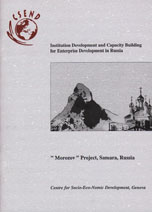
CSEND advised the European Bank for Reconstruction and Development (EBRD) in London on the design of a strategy to create a network of Business and Training Centres (BTCs) in Russia. The result of this process is the “Morozov Project”, consisting of over 30 Russian Business and Training Centres (BTCs) which were twinned with foreign organisations to help strengthen the institutional capabilities of the BTCs in areas of management consulting and entrepreneurial training. The mission of each BTC is to help create jobs and contribute to a more vibrant local economy by acting as a business skills training and resource centre. BTC stakeholders include local entrepreneurs, managers of recently privatised companies, and local officials. The ultimate goal of each BTC is to become economically self-supporting, and contribute to the sustainable development of Russia’s economy.
EBRD selected CSEND to “adopt” the Business and Training Centre of the city of Samara, located 1000 kms southeast of Moscow on the Volga river to help modernise its training programmes and consulting business.
CSEND assisted the Samara BTC in developing its capacity to provide training and consulting services to its client system in the areas of:
management development for large enterprises and military complexes undergoing conversion,
business development for small and medium-sized companies,
business creation by new entrepreneurs,
policy advocacy with regional government officials and business leaders.
Specifically, the programme of the Russian-Swiss partnership project comprised the following elements:
Business Development: CSEND assisted the BTC in assessing needs of the Samara region in consulting and training services, and in developing a marketing plan to implement its strategy.
Staff Development: CSEND provided consulting to the BTC in assessing skills and knowledge levels of its management, trainers and consultants and proposed a staff development programme to meet market needs.
Information System Development: CSEND advised the BTC in the implementation and maintenance of an effective management information and performance system to assist it in complying with the reporting requirements of the Morozov project.
Network Development: CSEND assisted the BTC in establishing linkages and relationships with its local community, including commercial banks, financial intermediaries, business associations and government institutions.
Small Business Creation: CSEND helped the BTC develop cooperation arrangements with EBRD-sponsored activities e.g. the EBRD’s Regional Venture Fund, Russian Small Business Funds and other loan or investment projects.
Results
After completion of the project, sustainable transfer of new management and consulting skills was made. Samara BTC was able to:
implement new administrative delivery systems,
train local regional business managers and government officials,
strengthen relationships between the BTC and the community, including associations with commercial banks, businesses and government agencies,
establish working relations with Swiss Chambers of Commerce and UNCTAD (Trade Point).
Samara BTC is now in a strong position to effectively contribute to job and enterprise creation in the Samara region.
Publications
Yiu, L., Saner, R.; “A Generic Working Model for Building Institutional Capabilities in Central & Eastern European Countries”. Centre for Socio-Eco-Nomic Development, Working Paper, 1994.
Saner, R., “The Impact of Policy and Role of Donor Agencies on Small an Medium-sized Enterprise (SME) Assistance Projects in Russia” in Trappe P. (Editor), Problembereiche Interdisziplinärer Forschung. Berne: Peter Lang AG, 1999. abstract
The seminar was organized jointly by Centre for Socio-Eco-Nomic Development (CSEND), UNCTAD, Future of the UN Development System (FUNDS) and Business Systems Laboratory.
A newly published book was introduced and a subsequent thematic debate focused on the question whether the current approach to measuring sustainable development is good enough to support sustainable development in developing countries. This debate is part of the larger discourse on Post-2015 sustainable development goals.
Important ideas were discussed such as the need to bring back immediacy and depth to the notion of sustainability; the need to measure comprehensively sustainable development (e.g. the current analytic framework does not measure social sustainability); the interface between individual behavior and institutional rules; the inter-generational aspect of sustainability and its cross-cultural perspective; and the importance of measuring progress towards human development goals.
Raymond Saner, “Financing the localization of the SDGs through PPPs: Need to assess advantages & disadvantages by local governments”; International Conference on the Localization of the SDGs and the Co-Construction of the Means of Implementation, Yonsei University, South Korea ROK, 23-24 February 2019
International Conference on the Localisation of the SDGs and the Co-Construction of the Means of Implementation , Yonsei University, South Korea ROK, 23-24 February 2019
Current literature from ‘United for Smart Sustainable Cities’ details key performance indicators that can be utilized by cities to track their progress based on SDG indicators. This can be extremely helpful for cities who have trouble collecting or displaying data. In many of the VLRs reviewed, cities used varying types of data when displaying data and methods of collecting the data. This lack of consistency when discussing progress can cause problems when comparing the progress made by cities and when determining the most successful methods of achieving sustainability.
Some cities and states supplemented or substituted SDG indicators with their own (a disclaimer that is above each individual matrix). The aim of the matrixes below is to contribute to the discussion surrounding cities and their mention of SDG indicators. Specifically, the question arises whether or not a city needs to use SDG indicators to achieve sustainability and resiliency. This article offers a matrix which lists the goals mentioned by each city or state in their voluntary local reviews and shows which indicators were specifically mentioned in VLRs as well as the language used in VLRs to describe progress on an indicator.