
GATS Financial Services Liberalization: How do OECD Members Schedules Impact Commercial Banking FDI?

Recent efforts to lay out an international regulatory framework relevant for fi nancial services liberalization, consolidated under the aegis of the World Trade Organization (WTO) and followed by the implementation of the General Agreement on Trade in Services (GATS), have provided market access to commercial banks seeking establishment in an important group of countries.

20090517_Paez_TRAD_42_6

ISO 22000’s potential impact on world trade in agricultural products

Hardly a day goes by without the media reporting on the difficult negotiations w i t h i n t h e Wo r l d Trade Organization (WTO) and the threat to international trade should there be no successful conclusion to the Doha Round.
The problem most often reported centers around market access for agricultural products from developing countries that cannot pass the prohibitively high level of tariffs of the industrialized countries.

20090305-IMS 22000 06E1

Tourism Development in Least Developed Countries: Challenges and Opportunities

Effective tourism development strategies require systemic thinking and comprehensive investment portfolio strategies regarding the tourism industry as a whole, i.e. going beyond investing in hotels, but also including transportation infrastructure, catering, restaurants, safe water, financial system etc. The destination countries need to review their tourism value & supply chains and identify structural impediments to the full utilization of their tourism assets and facilities. This paper shows how Least Developed Countries (LDCs) can define their tourism sector development and suggests a framework which can be used by a LDC to assess its tourism development potential. It can also be used by potential investors interested in investing in an LDC’s tourism sector who need to understand the broader context of doing business in LDCs.

Raymond Saner, Lichia Yiu and Mario Filadoro

Article

Lesotho, a tourism destination: An analysis of Lesotho’s current tourism products and potential for growth

Tourism development has been identified by the government of Lesotho, the International Monetary Fund as well as the United Nations World Tourism Organization as a sector that can reduce poverty as well as absorb many low or semi-skilled labour. Boosting the tourism sector in the Kingdom will inevitably work towards alleviating poverty in the Kingdom overall. This chapter applies a case approach in order to illustrate potential investment opportunities and tourism performance improvements in an existing ski resort in Lesotho.

Lichia Yiu & Raymond Saner with Marcus Raphael Lee

Article

Séminaire international sur le Thème : La Mise en Place et le Renforcement de Systèmes compétitifs visant à la qualité dur Tourisme, Alger, 2006

Alger, le 16 mai 2006, Prof. Dr Raymond Saner, Directeur, CSEND-Genève, Genève, le 20 mai 2006.Observations générales : Les participants étaient nombreux et les échanges entre intervenants et participants offraient d’excellentes opportunités de comparer concepts et stratégies visant à développer le secteur du tourisme de l’Algérie en particulier et des pays de la région en général.

Alger I Tourism

Algiers II Tourism

Rapport R. Saner

Rapport Final

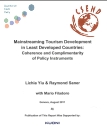
Mainstreaming Tourism Development: Policy Coherence and Complementarity (2011)

Tourism is a significant contributor to GDP, employment and to the international appreciation of a country and its culture – regardless of its level of development. This policy analysis seeks to assist the Least Developed Countries (LDCs) in harnessing development opportunities by providing a comprehensive overview of existing international development instruments, i.e., Diagnostic Trade Integration Studies (DTISs) and their Action Matrices, Poverty Reduction Strategy Papers (PRSPs), and reviewing their alignment with the national tourism development strategies, investment policies and tourism related trade arrangements.

The authors encourage the use of findings from this analysis by all actors and stakeholders engaged with trade facilitation activities in LDCs. In reviewing these key development policy documents, this in-depth analysis seeks to better equip LDCs to manage international policy advice provided by a multitude of international development partners. The ultimate objective of this work is to support their achievement of greater social and economic benefits through growth trade in tourism services. It is also hoped that this analytical report will enhance the coherence and complimentarity of tourism development advice proposed by the international community via drawing attention to policy gaps and implementation vacuums existing within the tourism supply and value chain.

Author: Lichia Yiu & Raymond Saner with Mario Filadoro
ISBN: 978-2-8399-0927-7

Cover

Executive Summary

Full text

Annex 1: Tourism References in DTIS, Action Matrix, PRSP and IPR

Annex 2: GATS Sector Specific and Horizontal Commitments

Annex 3: UNCPC classified GATS Sector Commitments
Annex 4: Country Risk Briefing

Annex 5: Country HDI Ranking