An interactive experiential experiment to engage the art spectators in an aesthetic exchange while going through an art event. A art event conceptualised by Raymond Saner (2005)
Details for the concept design, click here

An interactive experiential experiment to engage the art spectators in an aesthetic exchange while going through an art event. A art event conceptualised by Raymond Saner (2005)
Details for the concept design, click here
“Raymond Saner made an comparative analysis of the carnival culture in Trinidad and Basle. Both carnival festivities achieve significant economic and cultural performance and share common cultural roots.” Article was originally published in Baslerzeitung in German on 12th March 2011.
NEXT- Verein für bildende Kunst- represented by Luise Kloos organized together with the Nomadic University an oasis in Graz which was titled „China goes to Europe”. The cultural policy of China is to create Confucius Institutes (CI) all over Europe and also in Graz. In a series of lectures, experts discussed the historical, aesthetic, cultural, economic and educational implications of such a project. During a special Think Tank designed by Raymond Saner, the participants discussed the local conditions for such CI in the European context. The goal of the lectures and of the think tank was to generate insights that could be relevant for other European cities as well. The event was a collaboration involving NEXT- Verein für bildende Kunst, the Nomadic University, the City of Graz, the Land Steiermark and the Embassy of China in Vienna.
Economic inequalities are not god-given fatalities. They are manufactured every day by human actions resulting in poverty for those excluded from our societies. The production of economic inequalities consists of very specific political and social manipulations, often not easily visible to many of us.
We produce economic inequality by structuring our labour markets in such a way that wages are not determined by supply and demand alone or by skills and competences. In many countries, whether rich or poor, people are often not given a job because they have the wrong skin colour, gender, religious or sexual preferences or adherence to political parties considered negatively by those who do the recruiting
Interacting with local communities on local perspectives. Each oasis is documented by a series of research reports, publications and/or media productions for comparative and cumulative learning and research initiation on European leadership see: http://www.nurope.eu
The Oasis in Zadar, Croatia, was held on 23-26 August. Dr Lichia Yiu and Dr Raymond Saner represented CSEND and contributed to the Oasis with several activities. For reference, see sections listed below.
Programme
Visit to NGO on Dalmatian island
Presentations on Silk Road and Republic of Fiume
Republic of Fiume D’Annunzio RS
The Anarchist Banker
The Anarchist Banker by F. Pessoa
An “Open Space” Process of the EU Cultural Project for Intercultural Dialogue in Graz in October 2008
“Open Space” was a public event during the EU Cultural Project for Intercultural Dialogue in Graz on 12th October 2008. Prof. Raymond Saner facilitated this intercultural dialogue around the theme – Heimat, a German expression for the bounded-ness of people by their birth, their childhood, their language and their early experiences. Heimat in this sense constitutes the roots of one’s identity and belonging. An intercultural dialogue on the theme of Heimat allows exploration of the collective consciousness of cultural belonging and social interactions with the “other”.
Programme of the EU Cultural Project in Graz in October 2008
Art for Social Transformation and Intercultural Dialogue in Europe
2007-2008. The project explorer similarities and differences between the carnivals of Trinidad and Basle. It is to shed light on the historical and contemporary artistic and social expressions of carnival in both places
Joint project with the Museum der Kulturen (Museum of Cultures), Basle and the Office of International Programs at the University of Konstanz, Germany.
Slovakia, 5 December 2006
Bibliography
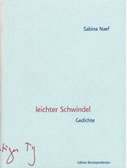
Sabine Näef studied German language and literature as well as romanistics, in Bordeaux, Lausanne and Zürich until the publication of her debut Zeitkippe in 1998. Since then works of lyrics and poetry have been published, such as tagelang möchte ich um diese Ecke biegen and leichter Schwindel. She was awarded several prizes and scholarships. Sabine Näef was born in 1974 in Luzern, where she lives and works today.
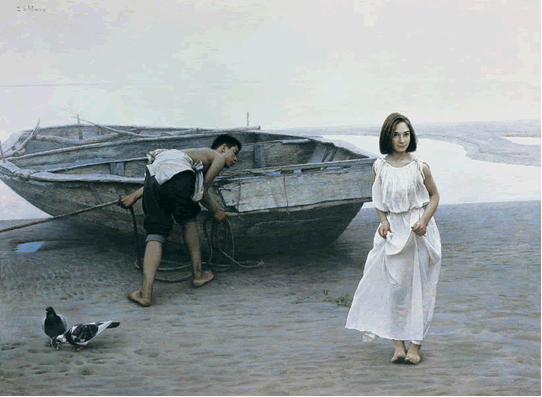
Please visit http://www.wanghongjian.com for more information
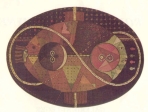
Please visit http://www.roman.lviv.ua for more information