
Research project titled “Trends and influence of private finance on global health initiatives and development goals in resource-constrained countries”, funded by the Swiss Network of International Studies (SNIS), CSEND (Lichia Yiu; Raymond Saner) as Consortium member with Swiss Tropical and Public Health Institute, University of Basle; Global Health Programme, Graduate Institute, University of Geneva, FUNDS, London, Franklin University, Lugano (Fall 2012-2014). Working Paper, 31st September 2012 to 30th April 2015.
Author: admin@csend.org
Inter-ministerial Coordination of Trade Policy at Central Government Level in Macedonia and Kyrgyzstan
Research project titled “Inter-ministerial Coordination of Trade Policy at Central Government Level in Macedonia and Kyrgyzstan”, funded by the Scientific Co-operation between Eastern Europe and Switzerland (SCOPES 2005-2008) programme, Swiss National Science Foundation, CSEND (Raymond Saner) as Research Project Leader.
Book publication: R. Saner, “Trade Policy Governance through Inter-ministerial Coordination: A Source Book for Trade Officials and Development Experts”, Republic of Letters, Dordrecht NL, 2010.
Governing the Use of Landscape and Habitats in the Alpine Areas: Negotiations as a Means to co-ordinate Stakeholder Interests
Research project titled “Governing the Use of Landscape and Habitats in the Alpine Areas: Negotiations as a Means to co-ordinate Stakeholder Interests”, CSEND (Raymond Saner) as consortium member, funded by Swiss National Science Foundation, 2002- 2004. Final document in book form “Staehelin, Elke, Saner, Raymond, Wagner Beatrice, “Verhandlungen bei Umweltkonflikten: ökonomische, soziologische und rechtliche Aspekte des Verhandlungsansatzes im alpinen Raum”, (Negotiations of environmental conflicts: economic, sociological and legal factors of Negotiations in the Alpine Region) , VDF Hochschulverlag AG, ETH Zürich, 2005.
In-Service Training as an Instrument for Organisational Change in the Public Administration: An International Comparative Study
Research project titled “In-Service Training as an Instrument for Organisational Change in the Public Administration: An International Comparative Study”, CSEND (Raymond Saner, Lichia Yiu) Initiator and Rapporteur of this Research Working Group, secretariat at International Institute of Administrative Sciences (IIAS) Brussels, participating countries Germany, Austria, Switzerland, Italy, Canada, Slovakia, Mexico, Hong Kong., 1994- 1997), final book publications: Saner, R.; Strehl, F; Yiu, L; ” In-Service Training as an Instrument for Organisational Change in Public Administration: A Comparative Study”, (in English and French) International Institute of Administrative Sciences, Brussels, 1997, and Saner, R.; Yiu, L.; Mindt, B. “Interface management of in-service training within the federal administration of Switzerland (German), Paul Haupt Verlag, Berne, ( 170 pp), 1997
1st Introductory Workshop on “Reconstructing the Social Fabric of Communities after War Trauma”
Humanitarian workers are confronted with systemic challenges when helping post-traumatic communities reconnect and rebuild. Specific skills and knowledge are needed to provide social reconstruction of the community and healing of collective and individual traumas. At the same time, support is also needed for the helping professionals who are often exposed to the danger of burn-out. “Sense making” is an important element in dealing with this occupational stress.
This one-day workshop aims at introducing key social science theories and techniques in reconstructing post-traumatic communities while lending support to the “helpers” who are pressed to intervene in uncertain territory with limited authority and leverage.
Learning Outcome and Benefits
Attending in this workshop, participants will be able to,
Brochure and application form here
1st Introductory Workshop Minutes – CSEND Technical Notes
Coast
A nominal fee of EUR 395/CHF 475 is charged to cover lunch, coffee breaks and administrative fees (click on Brochure for more payment information). All other expenses are to be covered by the participants such as accommodation in Geneva and travel to and from Switzerland. The CSEND staff will assist in making reservations for accommodation if so required.
Language Requirement
The workshop will be held in English. No interpretation will be provided.
Venue: World Council of Churches, Salle 4.The workshop will be held in English. No interpretation will be provided.
Venue: World Council of Churches, Salle 4.
Sino-Swiss project
Sino-Swiss project on “Policy Dialigue on Financing Higher Education and Sustaining the Quality of Higher Education for Lifelong Learning”
Under the auspices of the OECD, CSEND experts established a framework to facilitate the development of a research network between Switzerland and China. The focus of this research network is to carry out comparative studies concerning the management and financing of higher education in the context of life long learning. For more detailed information and background documents please check
Quality in Higher Education
CSEND chaired a panel and gave papers on “The link between higher education and employability” and another paper on “Quality Evaluation in a Diversified Higher Education System – at an International Seminar on the Development of Higher Education and Financing Policies co-organised by OECD, Paris and the Ministry of Education, Beijing, China July 2004.
Integrated Framework (IF), BAH-USAID
CSEND worked on a USAID-sponsored policy project for Booz Allen Hamilton. The goal of the study was to identify success factors of the Integrated Framework (IF) a WTO instrument targeted to support Least Developed Country’s supply-side deficiencies. Target interviews were conducted with officials of the Geneva-based IF agencies namely WTO, UNCTAD, UNDP and ITC. Geneva, August 2005.
CDM, European Climate Policy Research Seminars (ECPRS)
CSEND wrote background paper for a policy seminar on “Designing a Strategy to Improve the Functioning of the Clean Development Mechanism (CDM) of the Kyoto Protocol”, organised by the Centre for European Policy Studies (CEPS), Brussels. The title of the CSEND paper was “Hype or Reality: Can the CDM trigger FDI?, Brussels, October 2005.
Modernising Public Administration
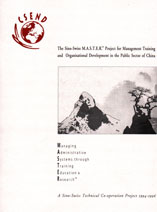
Administrative Reform through Training: Background The rapid growth of China’s economy over the past decade has put increasing performance pressure both on its public administration and on government officials, who have been compelled to acquire new skills in order to meet the complex challenges of the “four modernisations”. This pressure further increased after 1993, when more than a fourth of all civil service jobs were eliminated.
In 1994, CSEND was mandated to implement a three-year programme to assist the People’s Republic of China in modernising its central administration by improving management and training capabilities in government and public enterprises.
Continue reading “Modernising Public Administration”