CSEND Papers are publications of policy research and advocacy positions. They are lengthier than CSEND Policy Briefs and equivalent to a full academic paper
Formations et emplois circulaires en Suisse pour les travailleurs extra-communautaires: redessiner les contours des migrations du travail de demain
Le système qui régit l’entrée des travailleurs étrangers en Suisse répond de manière insuffisante voire inappropriée à la demande de main d’œuvre dans de nombreux secteurs. Avec le problème imminent du vieillissement de la population, des solutions efficaces doivent permettre à la Suisse de maintenir sa main d’œuvre à flot. Le recours à des travailleurs de pays tiers devient dès lors l’une des seules solutions efficaces pour éviter un lent démantèlement de l’économie suisse. Cet article révèle les dysfonctionnements de la politique économique d’immigration suisse et ébauche pour les politiques publiques un système de migration circulaire fiable pour les travailleurs semi-qualifiés qui, dans un esprit de bénéfice mutuel, contribuerait substantiellement à la bonne santé du marché du travail en Suisse, tout en offrant un appui crucial au développement du pays d’origine des travailleurs et à l’épanouissement des travailleurs eux-mêmes.
Humanitarian workers are confronted with systemic challenges when helping post-traumatic communities reconnect and rebuild. Specific skills and knowledge are needed to provide social reconstruction of the community and healing of collective and individual traumas. At the same time, support is also needed for the helping professionals who are often exposed to the danger of burn-out. “Sense making” is an important element in dealing with this occupational stress.
This one-day workshop aims at introducing key social science theories and techniques in reconstructing post-traumatic communities while lending support to the “helpers” who are pressed to intervene in uncertain territory with limited authority and leverage.
Learning Outcome and Benefits
Attending in this workshop, participants will be able to,
acquire a understanding of the complex dynamics which Characterise humanitarian work and assess how the concepts presented during the workshop can be fruitfuly applied to their own work .
become familiar with work tools which are part of emotional intelligence and supportive of artistic expressions of human experience that can help transcend barriers to human interaction and communication.
develop further their own working models of effectiveness and efficiency of humanitarian work in situations of community development in post-conflict situations.
A nominal fee of EUR 395/CHF 475 is charged to cover lunch, coffee breaks and administrative fees (click on Brochure for more payment information). All other expenses are to be covered by the participants such as accommodation in Geneva and travel to and from Switzerland. The CSEND staff will assist in making reservations for accommodation if so required.
Language Requirement
The workshop will be held in English. No interpretation will be provided.
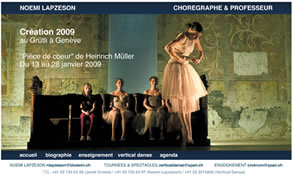
Naît à Buenos Aires. A 16 ans part pour NYC étudier la danse et la musique à la Juilliard School. Entre à la compagnie de Martha Graham une année plus tard comme la plus jeunne de ses interprètes. Reste 12 ans dans la compagnie, comme Soliste et professeur. Invitée à Londres pour créer une école et une compagnie, ele travaille comme danseuse, professeur et chorégraphe dans la London contemporary Theatre and School.
présentée par Caroline Coutau et Anne Davier vile de Genève
Noemi Lapzeson1940, naissance à Buenos Aires dans une famille d’intellectuels. 1980, arrivée à Genève. Entre ces deux dates, une vie qui ressemble à un roman. Ses premiers pas de danse, Noemi Lapzeson les fait avec une disciple de Jaques-Dalcroze. Déjà signe d’un lien avec Genève? A seize ans, elle quitte sa famille et sa ville pour s’installer à New York. Noemi est déterminée. Et a du talent. Donc ça marche. Elle vit la période la plus riche de l’histoire de la danse contemporaine, auprès de Doris Humphrey, Antony Tudor, José Limon, Merce Cunningham ou encore Alwin Nikolais, puis pendant douze ans dans la compagnie de Martha Graham, où elle est soliste. Mais l’Europe l’attire. En 1967, elle part pour Londres et crée avec Bob Cohen la London Contemporary Dance Company and School. Parallèlement, elle enseigne dans le monde entier: invitée à Montréal, à Toronto, à Angers, à Paris, à Tel Aviv, à Buenos Aires, elle s’arrête à Genève. Sa fille a trois ans, c’est le moment de s’installer un peu.
Nous sommes en 1980. Noemi ne parle pas un mot de français et Genève pas un mot de danse contemporaine. Ça va changer. Lapzeson est une pionnière. A peine atterrie, elle enseigne. Au Grand Théâtre, dans l’école de Beatriz Consuelo, au Conservatoire, mais surtout, elle commence ses cours privés qui vont peu à peu devenir une véritable institution parallèle. Et former ainsi plusieurs générations de danseurs à Genève.
Du côté de la création, les deux programmateurs de la Salle Patino de l’époque, Philippe Albèra et Jean-François Rohrbasser, la repèrent tout de suite. Depuis quelques années, ils invitent des Trisha Brown, Karole Armitage ou Lucinda Childs. Pourtant, Genève en est encore aux balbutiements de la danse contemporaine. Avec Noemi Lapzeson, le public genevois va peu à peu se constituer, suivre le travail de la chorégraphe, puis celui d’autres artistes. On peut la voir tourner sur elle-même dans une performance pieds nus et en tutu pendant soixante minutes. Dans There is another shore you know rendre au corps toute l’animalité qu’il a en lui. Tirer imperturbablement dans Limbes, états vagues les draps d’un lit imaginaire, sobrement, encore et encore. Puis il y a ce solo, Un Instant, où elle danse avec une chaise sur sa propre voix off qui dit le texte de Stig Dagerman Notre besoin de consolation est impossible à rassasier. « Je suis dépourvu de foi et ne puis donc être heureux, car un homme qui risque de craindre que sa vie soit une errance absurde vers une mort certaine ne peut être heureux. » Quarante minutes exigeantes et inquiètes à l’image de la chorégraphe, pendant lesquelles le spectateur est enveloppé dans une esthétique vibrante et pourtant étrangement sereine.
En 1986, l’Association pour la danse contemporaine (ADC), qui va définitivement métamorphoser le paysage chorégraphique genevois, se constitue autour de la chorégraphe. Entre les cours que donne Noemi, devenue entre-temps genevoise, et le travail de fond de l’ADC, c’est toute une génération de danseurs, de chorégraphes et d’amateurs de plus en plus éclairés qui, progressivement, vont développer à Genève une véritable scène de la danse contemporaine.
1989 est l’année où elle crée sa compagnie, Vertical Danse. Les spectacles s’enchaînent, souvent inspirés de textes littéraires, toujours en étroite collaboration avec des artistes d’autres disciplines, compositeurs, poètes, ou encore plasticiens. A cet égard, sa curiosité et son ouverture d’esprit sont exemplaires. Plus de trente chorégraphies sont créées, notamment Monteverdi, amours baroques, Géométrie du hasard, Madrugada, Opus 27.
Les signes de reconnaissance affluent. En 1992, c’est le Prix romand pour les compagnies indépendantes; en 1999 elle reçoit la bourse Guggenheim à New York; en 2002 le Prix suisse de danse et de chorégraphie; en 2006 le Prix de la Fondation Leenaards; et enfin, celui pour lequel ce trop bref portrait est écrit: le Prix de la Ville de Genève.
Si sa danse est un constat irrémédiable de la solitude de l’homme, elle mène à un état d’absence de soi, capable de tutoyer une certaine plénitude, comme dans sa dernière création, Eidos (forme définie), présentée en 2006. Grâce à un mouvement qui insiste sur la répétition, grâce au silence, aux images, aux espaces de lumières et grâce, surtout, à une esthétique formidablement épurée à force d’être travaillée.
Notice biographique Née en 1940 à Buenos Aires, Noemi Lapzeson arrive à Genève en 1980. Partie pour New York à seize ans, elle est pendant douze ans soliste chez Martha Graham. En 1969, elle crée à Londres avec Bob Cohen la London Contemporary Dance Company and School. Parallèlement, elle enseigne à Montréal, Toronto, Angers, Paris, Tel Aviv, Buenos Aires et… Genève, où elle enseigne d’abord au Grand Théâtre avant de donner des cours privés qui formeront plusieurs générations de danseurs. En 1986, elle fonde avec d’autres acteurs du monde de la danse l’Association pour la danse contemporaine (ADC) qui va définitivement métamorphoser le paysage chorégraphique genevois. En 1989, elle crée sa propre compagnie, Vertical Danse.
Principales chorégraphies Limbes, états vagues, 1981
There is another shore you know, 1984
Lussa, 1986
Je deviendrai Médée, 1986
Medea, Medea, 1987
Désir d’azur, 1988
Tues-tu, 1989
Monteverdi, amours baroques, 1990
Sequenzas/Cantus Planus, 1991
Un Instant, 1992
Le chemin où tu marches se retire, 1993
Traces, 1994
Péril à parler et à se taire, 1995
Promenades dans un jardin, 1996
Géométrie du hasard, 1998
Paysage vertical, 2000
Images en mouvement, 2000
Madrugada, 2001
Opus 27, 2002
L’une était l’autre et les deux n’étaient aucune, 2003
Intergenerational partnerships mean that “all generations work together to create change, rather than having to compete for their right to participation” (The Youth – Friendly Guide to Intergenerational Decision Making Partnerships, 2004).
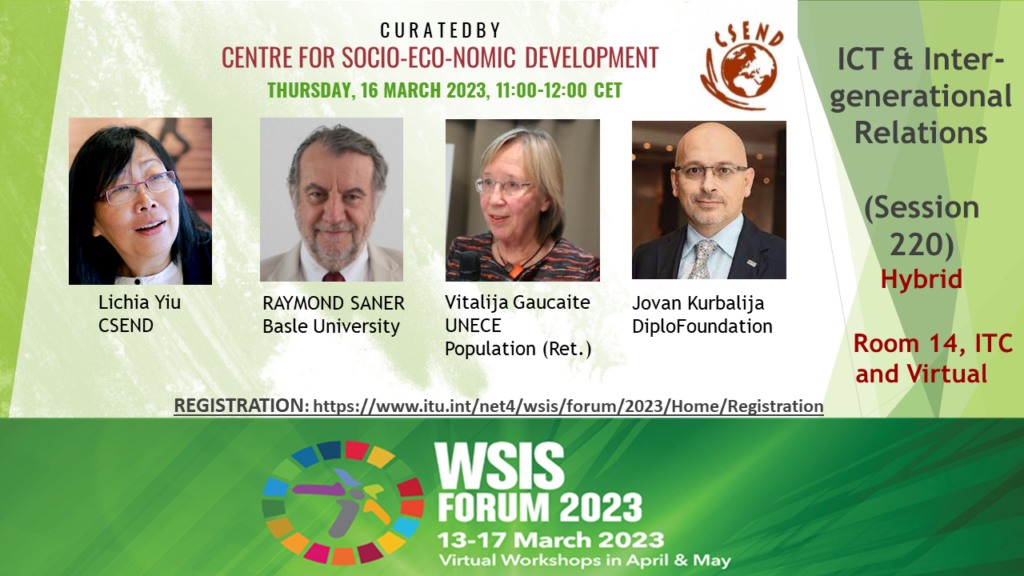
Creating intergenerational partnerships is challenging and will not happen overnight. This WSIS Special Initiative and Special Tracks brings together the stakeholder groups to explore and discuss how such partnerships could be created, facilitated and fostered to contribute to a sustainable future for all.
Raymond Saner (2023): “Older Persons, Digital Products and Standards: The need for consumer protection and support for continuous learning of older persons”, in Social Aspects of Ageing- Selected Challenges, Analyses, and Solutions, Edited by .Andrzej Klimczuk; open access journal: DOII:10.5772/intechopen.108983
This chapter addresses the need to help older persons adjust to the digital age and describes major challenges that aging persons as well as persons of all ages have to face in light of today’s virtual realities. The author proposes how to best facilitate and support older persons coping strategies and how they can obtain and maintain adequate digital literacy and ability to use existing digital resources. The article describes the hidden costs of the digital age for older persons and offers six solutions how these digital challenges could best be overcome from individual, social and public policy perspectives.
WSIS 2022: Digitalization and the future of work through inter-generational collaboration, panel organized by Raymond Saner, CSEND with following contributions: “Workforce aging, productivity and industrial structure in Europe (Prof. Iñigo Calvo Sotomayor, Deusto Business School, Bilbao, Spain); “Digitalization and the future of work through inter-generational collaboration- the case of Hong Kong” (Prof. Peter Fong, Ph.D, President, HK Public Administration Association); Intergenerational Collaboration on ICT: the AAL experience- a comparative analysis” (Klaus Niederländer, Director, Central Management Unit, AAL , Brussels); “ ICT voluntarism by young people to improve older persons’ digital literacy in China (Prof. Dr Yifan YANG.; Deputy Director, NIIA, Southwest Jiaotong University, Chengdu, China) and “Digitalization, future of work and participation across age groups” by (Prof Lichia Saner Yiu, President, CSEND, Geneva).
Monday, April 8 2019, from 4:30pm to 6:15pm, Room M, ITU
Information and communication technologies (ICT) have extraordinary potential to help with the response to the demands of a major demographic shift, including meeting the challenges of a shrinking workforce and improving healthcare and caregiving for older persons. Yet key challenges exist that need to be addressed, including accessibility of these technologies and digital skills for older persons. This panel will explore how older persons are using ICTs to ensure positive change for themselves and others, manage age-related challenges, and overcome risks, barriers and stereotypes. It will include speakers from a variety of stakeholder groups.
No international convention exists so far that would offer protection of older people. However, different initiatives have been launched to bring to the public’s attention that older people often experience severe discrimination (Ageism) and appalling situation in elderly care institutions and even at home in the context of family. The following institutions are contributing to the international efforts to create policies and international agreements that could lead to an international convention for the protection of older persons.
Statements prepared by CSEND and presented during the 9th Open-Ended Working Group on Aging (OEWGA). held in New York on 23-27 July 2018 at UN Headquarters in New York City
The Department of Ageing and Life Course organises its work according to the 5 strategic priority areas identified in the Global strategy and action plan on ageing and health 2016-202 such as commitment to action, age-friendly environments, health systems that meet the needs of older people, long-term-care systems and data and research. http://www.who.int/ageing/en/